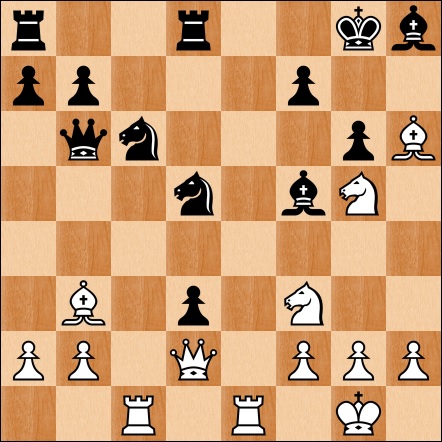
I tend to recommend the French (1.e4 e6) to people who are looking for a defence against 1.e4, partly because it's relatively easy to learn and partly because it can teach a lot about chess strategy via the clear pawn structures it contains. Yet occasionally I get students who like open lines for their pieces, and they find the French too closed and restrictive. They like the sort of game you get after 1.e4 e5, but how hard is it to learn to play like that?
The answer depends on a number of factors, not least of which is the time someone has available for study. White has a lot of options after 1...e5, some being quite quiet and others being wild, for example after 1.e4 e5 2.Nf3 Nc6 3.Bc4, White has both razor sharp approaches and quite ones based on d2-d3 and c2-c3. Another factor will be age, there's no doubt that younger players tend to find it easier to learn new things. Then there's the level at which you plan to use 1...e5, playing it in club chess is a very different matter to playing it against IMs and GMs.
At the same time there are exciting ways to play the French, for example after 1.e4 e6 2.d4 d5 3.Nc3 there are some very sharp lines in the Winawer (3...Bb4) and MacCutcheon (3...Nf6 4.Bg5 Bb4) variations. This is true of most openings, you have a choice about how sharp you want to make things. Admittedly the potential for early hand to hand combat may not be quite as great as with 1.e4 e5.
As with many such questions, a good way to proceed is to test the waters before diviing in. Learning a bit about 1.e4 e5, and trying it in online games, will give you valuable feedback about whether it is really for you. If you play it and feel comfortable, it may be worth a bigger time investment. If it turns out that you hate it, there's always the option of walking away.
Training Tournaments
This week's training tournaments return to the Colle System, with Black meeting 1.d4 Nf6 2.Nf3 with 2...g6. The first one will feature the King's Indian style 3.e3 d6 positions and the second the Gruenfeld style 3...d5; both were covered in my Building an Opening Repertoire course:
Sunday September 28th at 5pm UK Time: Colle vs King's Indian
Sunday September 28th at 6.15pm UK Time: Colle vs Gruenfeld
Video Discounts
This week's discount is 40% off buying Mastering Key Pawn: The Classical Centre, using the code 'sep26tooct4'. This video series considers the classical centre, which can arise from a very large variety of chess openings including the Semi-Tarrasch and Gruenfeld Defences, plus many others..
Last week's discount was 40% off buying the Mastering Key Pawn Structures: The Carlsbad Formation, using the code 'sep19to27', and it is valid until close of play tomorrow. This is a key pawn structure which I think can be used as a touchstone for understanding positional play. It occurs in several of my openings courses, this one is devoted fully to the topic.
My Upcoming Events
After Tenerife cancellation, I've accepted an invitation to the Scarborough congress, largely because my wife enjoyed going there last year. This is the only thing I have planeed right now, though I might also play in the Bolton Rapidplay in December.
October 24-26: Scarborough Congress
I played in this last year and it's a popular event. Details can be found here.
Have a good weekend.
Nigel